


Skilled marketers build campaigns on the foundation of simple, powerful insights. The right revelation unlocks messaging that truly resonates. You know — you’ve seen those ads, and you know. It can be easy to tell when the message is forced or built around an insight that the campaign stretched towards, instead of the other way around. However, there’s a major issue with this perfect approach: letting the campaign build off real truths about the audience or product takes time. So, if we know not to force an insight, how then can marketers unlock these commanding messages when deadlines loom?
At VI, several departments recently took time to train on the differences and advantages of convergent and divergent thinking. Based on J.P. Guilford’s 1967 book The Nature of Human Intelligence, these two types to thinking can be utilized effectively if reserved for the right setting. Good strategy often results from wisely deploying these two approaches, and understanding their differences will unlock insights and messaging avenues that can transform campaigns.
Divergent thinking uncovers a myriad of opportunities. It can be creative, risky, not all the way fleshed out and bucket-list-esque … the type of thing that often happens in a good brainstorm. This style of thinking results in multiple options or solutions, because thinking divergently with your team often allows for dreaming big and moving in many directions. If asked, “Where should we have our office holiday party this year?”, divergent thinking would result in comments like “Wouldn’t it be fun if we had the party at Disney World?!” or “I bet everybody would have a blast if we went to my uncle’s lake house in Missouri” or “There’s a new bar downtown, it would be great to rent that out for the party.” All exciting ideas, and all a result of expanding minds and exploring all possible solutions. There very well may be a winner in that brainstorm.
Convergent thinking, on the other hand, is best reserved for making a final decision and getting the job done. It’s structured, researched-backed and a result of trying to find the correct solution, when you already know what the outcome should be. If faced with that same question about the holiday party, thinking convergently would result in some thoughts like “Disney World would be fun, but it’s way out of budget. We should find something within the predetermined price range” and “The lake house would be within the price range, but traveling all the way to Missouri wouldn’t be ideal for everybody’s schedule” and “The new bar would be local and cost effective. We’d have to make sure they’re okay with us bringing our own food, and we’d need to confirm that they can rent to us for the whole night … But we should definitely look into it.” All thoughts that are driving towards a final solution that might satisfy the needs of the situation. Holiday parties aside, utilizing these two approaches at the appropriate times can be incredibly useful when planning for a new campaign, writing a brief or revising an existing campaign.
Try divergent thinking when your team is trying to:
- Uncover a problem
- Develop a solution
Focus on convergent thinking when it’s time to:
- Define a problem
- Deliver a solution
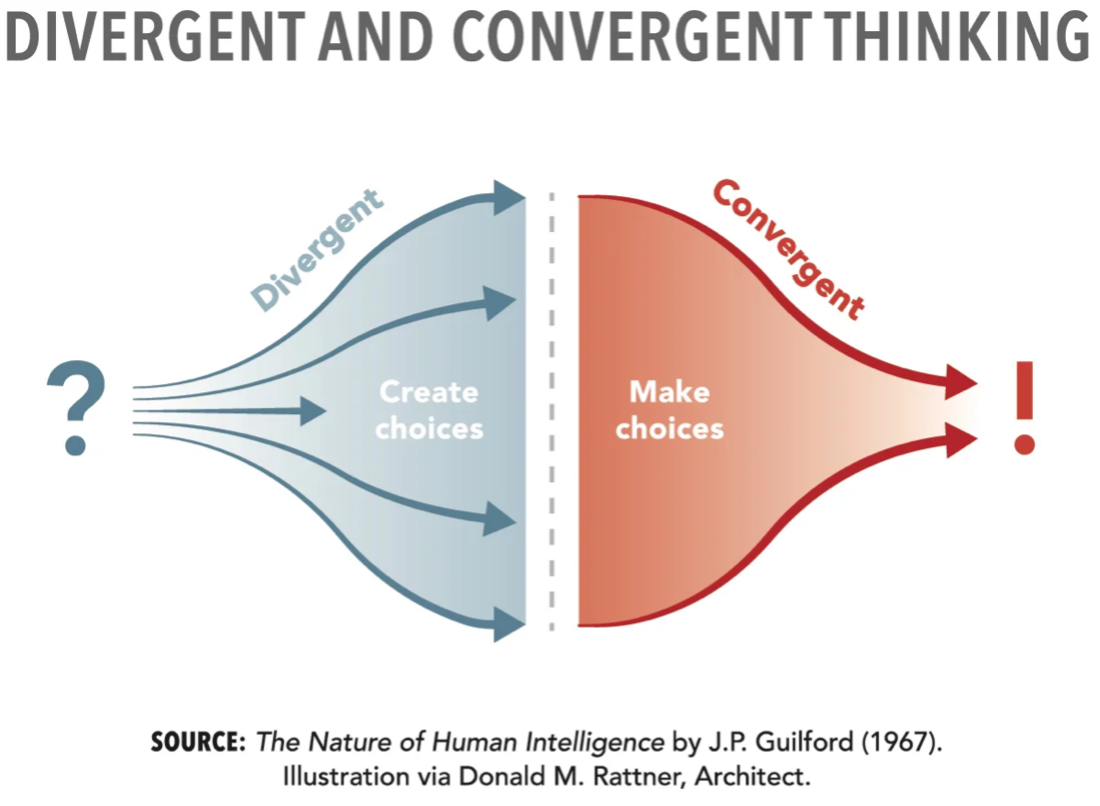
On the subject of delivering solid strategic direction, what’s important is not thinking convergently too early. Unlocking key insights that lead to good strategy can’t come as a result of convergent thinking in the research phase, chasing one thing from the start. Searching for an insight by going to the data will come off as forced, and finding neat insights shouldn’t be treated like a Google search. Letting insights come as a result of divergent thinking (being curious and flexible) while gathering and analyzing research will almost always lead to sounder strategy and higher quality outputs. This way, you avoid convergent thinking holding you to one pre-decided direction which gives no rigidity when the brief exposes a new and exciting direction.
A good insight will allow your campaign the luxury of simplicity, because there’s no need for complication when things are grounded in truth. Goodby and Silverstien are famous for doing this well, and their trademark way is traditionally executed by taking a commonly viewed negative element of the brand and exaggerating it for comedic effect. Take their “Other Hand” campaign for Cheetos, which won several Cannes Lions, Best of Show Addy’s and led to +5,000,000 increase in units sold.
This campaign was built on an unassuming stat in the brief: 99% of people eat Cheetos with their dominant hand. Well, now they’ve got the infamous Cheeto “dust” on their best hand, leaving them to operate their lives with their non-dominant hand, right? Silly thing to focus on, yet relatable, eye-catching and based on real truth. These unique approaches came as a result of divergent thinking near the beginning of the process. Up front, having the open mind and eyes to consider these unique approaches and find insights that can grow into great ideas often comes from intentional, freely-moving divergent thinking … resulting in the type of message that makes you think “Ha! I’ve never thought about it that way …” Of course, convergent thinking helps decide on and deliver these insights into powerful campaigns, as skilled convergent thinkers will take the unlocked insight and grow it into fleshed out strategy, based on brand objectives, customer journeys, media execution strategies … the whole works.
The important thing in the early stages is allowing your team and process the space and time to explore, gather info and identify strategies that may feel hidden at first. These approaches often lead to incredibly powerful work. If your team is looking to execute or create a campaign, VI would be honored to help walk through the process and unlock meaningful insights that lead to effective creative. Shoot us a note, and let’s get to work.